
Your site ranks third on Google for your main keyword, and the monthly SEO report looks healthy. Then a prospect asks ChatGPT or Perplexity, “Who’s a good agency for X?”, and your business doesn’t come up at all. A traditional SEO report won’t catch that gap.
That gap is the reason Search Engine Land published a list of eight GEO (Generative Engine Optimization) metrics to track in 2026. The first on the list is AI citation frequency: how often generative systems consider your content useful enough to reference. The recommendation is to measure it across Google AI Overviews, Google AI Mode, Perplexity, and ChatGPT search.
This article covers the metrics we have found most practical for businesses, especially those just starting to take GEO seriously.
Why Rankings Alone Fall Short
Rankings measure your position in a list of blue links. AI answer engines work differently. They read many sources, summarize them, and then name only a handful of brands or link a few pages as references. A page can rank near the top of Google and never be cited by an AI, and the reverse happens too.
So the question changes. It is no longer just “Where do we rank?” It is also “Are we mentioned, how often, and how?”
The GEO Metrics Worth Tracking
AI citation frequency
This is the starting point. Build a list of the questions your prospects actually ask, somewhere between 20 and 50, and check regularly whether your site is cited in answers from ChatGPT, Perplexity, Claude, and AI Overviews. Use the same question set every month so the comparison stays fair.
Share of voice against competitors
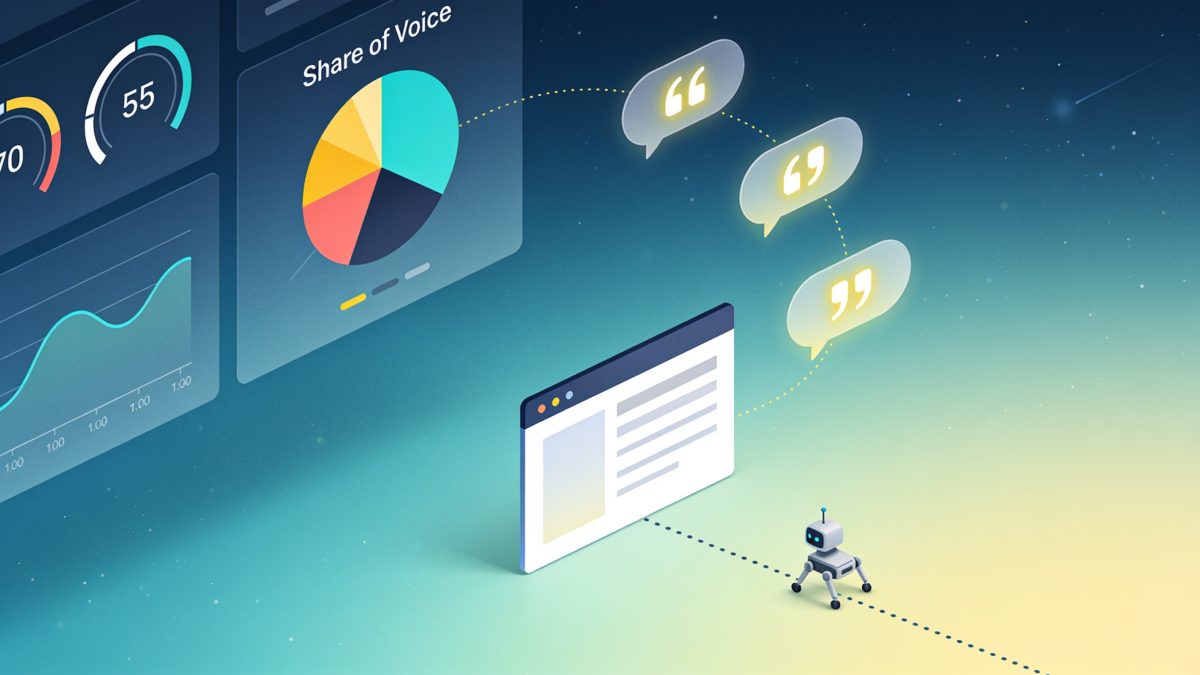
Citation frequency tells you your absolute visibility. Share of voice tells you where you stand against competitors. Across all brand mentions in AI answers to your question set, what percentage mention you, and what percentage mention competitors? This number tends to be more useful in strategy conversations than raw counts.
Citation share
This is related but different. Share of voice counts brand-name mentions, while citation share counts how often your site appears as a linked source. A brand can be named without being linked, so watch both.
Cross-engine breadth
Each AI engine has its own preferences about sources. Being cited often in Perplexity but never in ChatGPT is a gap worth knowing about. Track how many engines you appear in, not just your favorite one.
AI referral traffic
In Google Analytics 4, you can segment visits from chatgpt.com, perplexity.ai, claude.ai, and other AI sources. The volume may still be small next to organic Google traffic, but visitors arriving from AI answers often show up further along in their decision, because they have already been given a recommendation.
Mention accuracy
Being mentioned isn’t automatically good news. AI answers sometimes quote old pricing, services you have discontinued, or a description that is simply wrong. Check whether what is said about your business is accurate. When it isn’t, there is usually a page on your site that needs to be clearer.
AI crawler access
This technical metric is often overlooked. AI engines can’t cite a site they can’t crawl. Make sure robots.txt allows GPTBot, ClaudeBot, PerplexityBot, and Google-Extended, then check your server logs to confirm those bots are actually visiting.
Branded search lift
When people hear your name in an AI answer, some of them go and search for it on Google. A rise in branded searches in Search Console can be an indirect sign that your AI visibility is starting to work.
Getting Started Without a Big Team
You don’t need to track everything on day one. A sensible order: first, fix crawler access, because without it nothing else matters. Second, build your question set and measure citation frequency as a baseline. Third, set up AI traffic segments in GA4. After two or three months, share of voice and accuracy start to give you a meaningful picture.
On timing, we are direct with clients: GEO, like SEO, takes around three months before real movement shows up. What drives it is consistent monthly work, such as adding an llms.txt file so AI engines have a clear index of your content, implementing FAQPage schema so answers are easy to quote, and structuring pages with a clear answer near the top.
Start With One Simple Question
Before dashboards and reports, there is one thing you can check today: can AI search engines find and read your site? Plenty of businesses block AI bots in robots.txt without realizing it, or have key pages structured in a way that makes them hard to cite.
dpanell offers a free check for exactly that. Run an AI search visibility audit on your site at https://dpanell.com/ai-search-visibility-audit.php and see whether ChatGPT, Perplexity, and Claude can find your business.